and this is the best new interactive mapping site I’ve seen that easily lets you track the storms and, more importantly, visualize what areas are at risk. As always, please heed all warnings regarding these storms!
Posted by: Peter Black | August 18, 2009
It’s Hurricane Season Again
Posted in Uncategorized
Posted by: Peter Black | August 5, 2009
The UN and Google Team Up on Climate Map
Check out this interactive map system they made to show CO2 emissions. Pretty cool huh? What’s going on in Sweeden? Why is Latvia down almost 200% from 2006?
Posted in Uncategorized
Posted by: Peter Black | July 29, 2009
Who’s Tweeting about Climate Change?

This prototype map queries Twitter for geographically located messages. While still a work in progress (need to work on auto refresh and redundancy in the info window), this allows anyone to see a current map of who’s saying what regarding climate change.
Posted in Solutions, Status Quo | Tags: climate change, google map, twitter
Posted by: Peter Black | July 21, 2009
Tracking EU CO2 Permits with Google Maps
Check out this fine interactive mapping application that shows who’s getting the carbon allowances for the EU’s cap and trade program.
Unfortunately, the EU hasn’t reduced their carbon emissions much, apparently because the caps are pretty weak. This mapping application shows why that may be the case and who’s benefitting from a weak cap and trade system.
This is one of the nicer interfaces I’ve seen for this type of app: clear, easy to use, and intuitive. Bravo to the designers and engineers who created it… I may be into using much of your source code and design set in the very near future
Posted in Solutions, Status Quo | Tags: Cap and Trade, Carbon Emissions, climate change, CO2 emissions, EU, European Union
Posted by: Peter Black | July 21, 2009
World Bank Launches Climate Data Portal
And it’s pretty clunky if you ask me.
Hey, at least they’re trying. And incorporating motion chart is a good move, though I would have used google maps for the main mapping interface.
The biggest problem from my perspective is the technical jargon they use for most of their data without any context. To be effective, a user should understand the map within 10-15 seconds. Try doing that with the “adjusted savings: particulate emissions damage (% of GNI) data.
um…thought so.
Posted in Status Quo | Tags: climate change, data, maps, portal, World Bank
Posted by: Peter Black | July 20, 2009
Why all the images are broken on this blog
The reason is that in moving from EDF’s servers back to a ‘generic’ wordpress blog, all of the images were left behind. WordPress doesn’t appear to have the ability to batch import all of these images and reference them correctly. So, bear with me, I may have to do this by hand, or I may blow the whole thing off and begin anew with relevant maps that I’m working on.
If you have any ideas regarding how to remedy this, please feel free to let me know!
Posted in Uncategorized
Posted by: Peter Black | June 5, 2009
California Green Jobs Maps Get Some Nice Press
Since I’m leaving tomorrow for Europe (yes, I’ll be offsetting my carbon…), I don’t have time for a long blog post. So check out this LA Times Article.
Posted in green economy, Solutions | Tags: green economy, Green Jobs, maps, Solutions
Posted by: Peter Black | June 4, 2009
Back Where We Started…
…and he we go round and round.
Damn I love the Kinks.
The big news for me is that I’m no longer employed by the Environmental Defense Fund. My time there was excellent, and they are a fabulous organization doing all it can to pass comprehensive climate legislation. The Climateatlas was conceived in part to help with that specific cause, and now that I’m no longer with the company, some of you might be wondering what that may mean for this blog.
I have always felt, and continue to feel that the climate change issue is too large for most of us to perceive. The role of a geographer/geo geek like me who has invested significant time and energy into this issue is to help catalog spatial information pertinent to the issue, thereby helping to strengthen awareness and perception. As far as communication devices go, maps are pretty killer. Take the cartogram I posted a couple of weeks ago. How long did it take you to understand the two relatively complex issues it demonstrates? Not long I’ll bet.
That’s why I’ll continue to update the Climateatlas when I can (while I’m looking for new gigs and what’s next for me career-wise). I’ll keep tabs on the climate change world and will post cool maps from around the web, the blogosphere, as well as content I create myself.
Thank you for supporting my work, and I hope you keep reading this blog!
– Peter
6.4.2009
Posted in Uncategorized
Posted by: Peter Black | May 20, 2009
British Medical Journal: Climate Change will Affect Billions
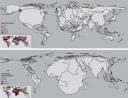
This is a cartogram that speaks volumes.
The lead author of the report states:
The big message of this report is that climate change is a health issue affecting billions of people, not just an environmental issue about polar bears and deforestation.
But the deeper message, as the Washington Post’s Ezra Klein reported in his blog the other day, is that while America leads the world in per capita co2 emissions, the burden of climate change will fall on the global south. Not a pretty scenario.
This might be the best graphic I’ve seen that encapsulates the drivers behind climate change and the predicted mortality that could come.
Posted in Status Quo | Tags: climate change health, global health, global warming, north south disparity
Posted by: Peter Black | May 15, 2009
California Green Jobs Map Released
 Check it out: my colleagues and I have created a rather large set of green companies in California to share with the world. The methodology is a bit different from the Less Carbon More Jobs maps we created, but it does give us some sort of picture as to how California’s Global Warming Law has positioned the state for growth under a carbon dioxide cap and trade law.
This map is still a little raw. For example, it currently defaults to LA county. That’s because there’s a limit to how many points you can publish at once on a google map. Today I created some back end data that will also zoom you to whatever geography (in this case: county, congressional district, or city) you filter the map by, making the user experience a little smoother. Bear with us!
Please tell us what you think!
Posted in green economy, Solutions | Tags: california, Clean energy, Clean Tech, green economy, Green Jobs
 Climateatlas